Enlightenment as Mass Destruction*
Sunday, November 12, 2006 by Jeff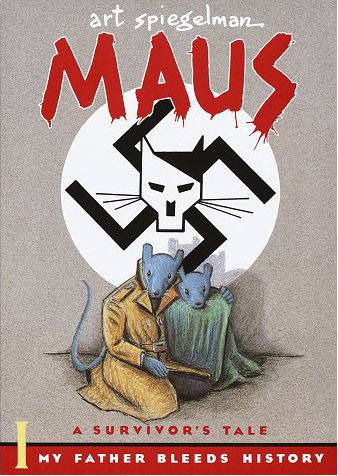 I'm told that my great grandparents, a Jewish family from Northern Europe - Germany (then Prussia) and Poland region - immigrated to the U.S. around 1900, effectively evading the Hitler's genocidal wrath before it emerged. The families they left behind were not so lucky.
Art Spiegelman's family also came from N. Europe (Poland), but not until after the war. Spiegelman was 29 in 1977 when he began interviewing his father about his experiences in the Holocaust. I just finished reading his Pulitzer Prize-winning, 2-volume comic, Maus: A Survivor's Tale (Pantheon Books, 1993) that recounts those interviews with his father. Well worth the read. It has provoked in me a morbid curiousity about my own distant relatives who didn't survive the war.
Spiegelman's father and mother were living and eventually hiding in Poland when they were captured by the Nazis and sent to Auschwitz for the final year of the war. As the Allied troops advanced, his father was made to dismantle the massive gas chambers and crematoria amidst the Germans' hasty retreat. Through stories such as these, Spiegelman writes with remarkable detail about the constant threats on his father's life and the survival strategies that kept him out of the camps for so long as well as those that kept him alive once he could no longer avoid them. [See a sample page from the book here.]
As if to drive the point home, tonight I saw Sacha Baron Cohen's Borat, the much talked about and critically acclaimed story of a Jew-hating Kazakh journalist who traverses the U.S. provoking outrageous and unscripted reactions from anti-semitic, racist, sexist, and homophobic Americans. The anti-semitic humor ("In Kazakhstan, three main issues: economic, social, and Jew.") - made even more perverse by the fact that Cohen himself is Jewish - is both hilarious and sickening, as when the gun store clerk suggests which types of guns would be best for hunting Jews. In this film, it should be said, the "-isms," and the people who espouse them, are the ultimate butts of the joke.
Given my reading of Maus, subsequent thinking about my family's heritage, and now seeing Borat, it's been an odd and thought-provoking week. I find that I'm still coming to terms with the recency of those 11 million horrific deaths - it was only 60 years ago! In that light, the current American animosity toward Jews, gays, Muslims, and women unearthed in the film is a grim reminder that we may not have changed as much as we'd like to think. If the film reveals our discrimination, Abu Ghraib and the debate(!) about torture expose our willingness to act. If the world slips into more fighting among nations for the top spot as some social scientists predict, will we see another Holocaust? Is it realistic to think that genocide will never happen here? Have we really come so far?
* The Culture Industry: Enlightenment as Mass Deception, by Theodor Adorno and Max Horkheimer (1944).
Labels: anti-semitism, Borat, Maus

 | »
| »


