Sunday, May 06, 2007 by Jeff
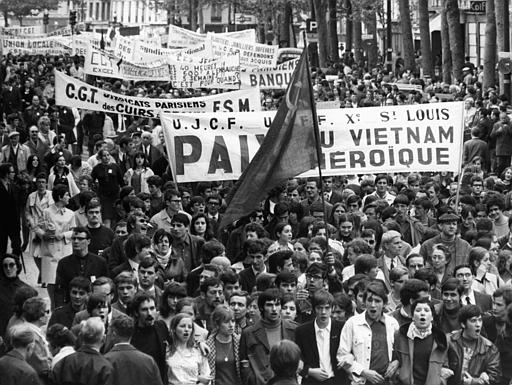
 As Congress squares off on proposals to de-fund the war and bring the troops home, the NY Times reports that the antiwar movement is finding success by moving away from social movement strategies. As Congress squares off on proposals to de-fund the war and bring the troops home, the NY Times reports that the antiwar movement is finding success by moving away from social movement strategies.
“The principle under which we’ve been operating is more like a political campaign,” Mr. Matzzie said.... The discussion at the retreat mirrored that of planning meetings for traditional political campaigns, with presentations on polling, strategy and field operations.... “The whole movement has updated themselves to be where campaign-style politics are generally,” said Stephanie Cutter, a Democratic strategist. “They’re just incredibly savvy, tactically and politically. They know how to use the news cycle.”
Finally! Those idealistic do-gooders are beginning to wake up and realize that sit-ins, marches, and other acts of civil disobedience aren't getting them anywhere. Welcome to Washington, kids!
Wait...hang on a second. Maybe - now just bear with me for a second here - maybe its the Washington insiders who are warming up to social movement strategies?
Many of the major players in Americans Against Escalation in Iraq earned their stripes not from sit-ins, marches and other acts of civil disobedience but as Democratic operatives on Capitol Hill and in political campaigns. The sophisticated political operation they have built is a testament to how far the antiwar movement has come since the Vietnam era.
Cha-ching! But this is really nothing new. Social movements have long worked with political elites who sought to strengthen their own political capital with claims to be the voice of the people. Sociologists have argued that social movements gain political leverage when they throw their numbers and organizational weight behind one or the other political faction in a time of heightened political division (as we are seeing now, especially with election season in full swing).
It's probably more accurate to say that the antiwar movement and Democratic insiders are both taking steps toward the other. The result is a tenuous, trans-beltway coalition being pulled in two directions toward their respective fields, and we should not be surprised by disagreements over goals and tactics.
“There’s a dividing line between those groups who feel the most important thing is to be clear on bringing the troops home as soon as possible, and the groups that feel that unity within the Democratic Party is most important and the most important thing is for the Democrats to win the White House,” said Medea Benjamin, a co-founder of Code Pink, an antiwar group that is not part of the alliance. “So the groups who feel the most important thing is to win the White House would naturally be more inclined to listening to Speaker Nancy Pelosi when she says the only way we can get a vote through is if we water it down.”
Watering down issues has long been the province of large, bureaucratic organizations (like political parties) bent more on survival than achieving their stated goals. If Democratic Party survival - e.g., in the next election - remains tied to opposing the war, as it has within the last year, then we should see more trans-beltway organizing. However, as Democrats begin to stake their political territory in the presidential race we are likely to see greater divisions (more frequent, though not necessarily more pronounced) and an increasing diversity of proposals about how to best end the war. This doesn't bode well for their social movement pals.
Social movements, for their part, include a range of organizations that range from living room meetings of neighbors planning banner-hangs and mock funerals to massive non-profit organizations housed in DC making personal visits to congressional leaders. Movements aren't centrally coordinated so they are more likely to develop factions and break apart. Each organization's position vis-a-vis the political field shapes the nature and timing of its response (if any) to changes in that field. The longer the Dems drag out the antiwar debate and as the election draws nearer, social movements (and coalitions like Americans Against Escalation in Iraq) are likely to feel increasing pressures pulling them both into and out of electoral politics. The larger, bureaucratic organizations will tend to cozy up to the party while smaller, decentralized organizations will cling firmly to their strident rhetoric of ending the war immediately.
This same dynamic has led to the collapse of many a social movement, as "moderates" clamor to get inside the beltway while "radicals" are increasingly marginalized, repressed, and driven to failure. Is it inevitable? Can the antiwar coalition maintain momentum with support both inside and outside the beltway? This article by a Boston University historian about congressional opposition to the Vietnam War suggests that we've been here before and party politics, albeit "sophisticated" and "saavy," is at best a very slow process. Ten years before the end of that war, Congress was debating and passing legislation to stop funding it. So I ask you, should the antiwar movement be moving closer to electoral politics? Labels: Democrats, news, organizations, politics, social movements
  | » | »
Friday, January 19, 2007 by Jeff
I've made the list. David McCarth... I mean, Horowitz, David Horowitz, who wrote a book naming the 101 "most dangerous" (leftist) academics, has been letting that list grow on his website. You can now find me and my course, Political Indoctrination...
Wha?
...well, we call it Collective Behavior and Social Movements. No kidding - there's a page there dedicated to me! But before you read it, some background.
Horowitz is the figurehead and driving force behind a social movement against leftwing influence in academia because it threatens to indoctrinate the malleable young minds of the next generation. The David Horowitz Freedom Center (DHFC), founded in 1988 by the man himself, is a self-described "battle-tank, not just a think tank," with a budget of $5.8 million. It does a lot of writing, speaking, hosting celebrity-studded events (John Ashcroft, Sen. Jon Kyl, Newt Gingrich), and pushing its "Academic Bill of Rights," a carefully worded libertarian manifesto of free speech and neutrality in education. As a 501(c)3 (non-profit) organization, DHFC cannot directly engage in political activities, so that's left to its ally, also a Horowitz brainchild, Students for Academic Freedom (SAF).
While looking over SAF's official handbook [pdf] for new chapter organizers, I couldn't help but notice some things that my students would pick up on. The first piece of advice in the section "recruiting members" takes a page right out of the classic study by Snow et al. (1980) on the topic (which we study in the class): "It is easiest to recruit members from a pool of likeminded friends or acquaintances." True, so true. And, of course, you can't very well build a movement without people to carry the pickets, but new recruits are just one of many resources you'll have to mobilize. SAF recommends "also try attending the meetings of other groups on campus and asking to make a brief presentation about the goals of SAF to see if they would be interested in joining." My students would recall McAdam's (1988) finding that new recruits are more likely to be members of other organizations or have previous activist experience. Damnit! ...there I go again, indoctrinating!
Here's a webpage dedicated to me and the danger I pose: how can you resist?
If you want to look for your friends, neighbors, or colleagues on this list, check here. Is there a SAF chapter on your campus? Go here and click "SAF Chapters." Arizona doesn't seem to have a one up and running but it does list a local representative. So I might extend him an invitation to talk to my class while we're learning about the Zapatistas and collective action frames.
 His primary achievement has been in confusing the public mind, as between the internal and the external threats of Communism. We must not confuse dissent with disloyalty. We must remember always that accusation is not proof and that conviction depends upon evidence and due process of law. We will not
walk in fear, one of another. We will not be driven by fear into an age of unreason, if we dig deep in our history and our doctrine, and remember that we
are not descended from fearful men. His primary achievement has been in confusing the public mind, as between the internal and the external threats of Communism. We must not confuse dissent with disloyalty. We must remember always that accusation is not proof and that conviction depends upon evidence and due process of law. We will not
walk in fear, one of another. We will not be driven by fear into an age of unreason, if we dig deep in our history and our doctrine, and remember that we
are not descended from fearful men.
Edward R. Murrow (1954)
Update: See the article in the Tucson Weekly. Labels: politics, social movements, university
| »
Tuesday, January 16, 2007 by Jeff
The conference is in August, but the deadline is tomorrow. It's gonna be a loooong night. I've been here before and it's never a pretty sight. Sleep deprivation is meant to be a torture method, not a work routine.
 Ever wonder why social movements don't change much? I mean, they've done the same stuff since the Jefferson administration. What gives?
Is it because they've found the best way to get what they want? Or is it because they have no other option? I've wondered this very thing and have come up with a different answer. And before tomorrow I'll have 20 pages making my case. It won't be pretty (and neither will I by that time) but it'll be adequate to meet the ASA deadline. At that time I may make it available through eBay for a reasonable price. Or here. Labels: graduate school, social movements
| »
Monday, November 20, 2006 by Jeff
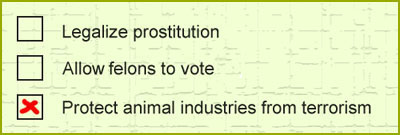
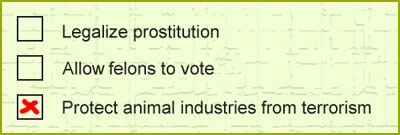
Clearly, some policy reforms are more plausible than others. Take for example the "Animal Enterprise Terrorism Act," passed by the House last week and now awaiting the President's signature. You know all those animal liberationists running around releasing mink, vandalizing McDonalds restaurants, and threatening vivisectors? Well we already have laws targeting them. But...why miss a golden opportunity to shore up your political base by expanding the reach of these laws in the name of the War on Terror?
Sure, civil libertarians may quibble with the sweeping breadth of the new bill (animal rights tactics that threaten a company's profits - e.g., nonviolent civil disobedience - will be treated as terrorism), but you're not likely to find many politicians willing to risk political capital on a bill like this (silly Rep. Kucinich!).
Championing prisoners' rights - you know, the little stuff like voting or protection against rape - may not be politically expedient but these issues do seem to be becoming thinkable. 16 states have already loosened their disenfranchisement policies in the past ten years, and with 80 percent of Americans in support of restoring voting rights to former felons, surely politicians are clamoring to introduce such legislation, right? Uh-huh.
On Saturday night I attended an event artfully dubbed "Whores Not Wars." It was at once an anti-war and pro-sex worker fundraising event for Food Not Bombs and the local Sex Workers Outreach Project:
...featuring provocative live performance art, whore stories, lap dances, sexy soldiers, and anti-war, pro-whore activities...Prepare to be titillated, disturbed, outraged, pleasured, stimulated, and shocked! Bastardized military gear, pro-peace costumes encouraged! Legalization of prostitution and the de-stigmatization of sex work are top priorities for this group of current and former sex workers. Without saying anything about the group's abysmal success at organization-building, I can say with some confidence that achieving their stated goals will be a herculean political task. It's easier to imagine prostitutes at the center of a political scandal than at the center of legislation to protect their rights.
The political process has a way of pushing minority voices to the margins...and then outlawing them. Once they're outlawed, it sometimes takes away their rights to protest, or vote. It's times like these that social insurgents might want to reevaluate the targets of our campaigns. "Rights" don't always come down from the government but sometimes have to be taken up in other spheres like the economy, education, and religion. This is not to say that change will come necessarily come more quickly there, but some issues seem more apt for political campaigns than do others.
Follow-up (11/22/2006): Animal protectionism is on the ballot in the Netherlands today and stands a damned good chance of winning. That country's Party of the Animals is widely expected to become the "first animal rights party in Europe to have its own lawmaker," as it has been polling between 130-140,000 votes (50,000 are needed to gain a seat in the legislature) [1]. It certainly is amazing how a proportional-representation system can change the possibilities.
Labels: animal rights, politics, social movements
| »
Friday, October 06, 2006 by Jeff
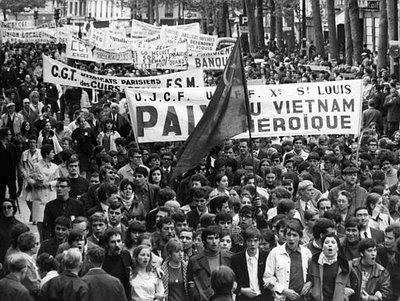 If you listen to people who study social movements there is little doubt about where protesters stand in relation to existing institutions: If you listen to people who study social movements there is little doubt about where protesters stand in relation to existing institutions:
"...contentious politics organizes on the boundaries of institutions and is never truly accepted by institutional elites." (Tarrow 1998: 67)
In fact, they all agree. Social movements are not institutionalized. Indeed, that's precisely why regular people use them:
Collective action becomes contentious when it is used by people who lack regular access to institutions...Contentious collective action is the basis of social movements...because it is the main and often the only recourse that ordinary people possess against better-equipped opponents or powerful states." (Tarrow 1998: 3)
Study after study shows social movements at their most powerful when they disrupt the daily routines of institutions, and it is when they lose their disruptive edge that they run the risk of being "absorbed and institutionalized into ordinary politics" (Tarrow 1998: 9). This is when they start acting more like an interest group, a lobby, or a political party.*
The paradox of social movements then lies in their remarkable persistence. This purportedly non-institutionalized form has hardly changed in roughly 200 years. When 19th century campaigners for parliamentary reform hit the streets they did pretty much the same things that 21st century immigration activists do: picket, demonstrate, march, boycott, petition, strike, form organizations, solicit media attention. Certainly these organized campaigns seek to influence existing institutions, but why stick with such (dare I say) antiquated techniques? Put differently, why is there "such startling homgeneity of organizational forms and practices" (DiMaggio & Powell 1991: 64)?
* It must be said that social movement scholars are guilty of a longstanding bias favoring movements oriented toward politics and the state. So when they talk about institutions they really mean the polity, and in that context social movements most certainly are marginal actors. Labels: social movements, sociology
| »
Monday, September 11, 2006 by Jeff
Last night in Tucson two columns of light rose from the downtown skyline, a ghostly image of the Twin Towers (borrowing from a new New York tradition). Together with the week's effusive talk on television, blogs, and in classroom discussions about the fifth anniversary of the 9/11 attack, terrorism, the War on Terror, al-Qaeda, conflicts in the Middle East, and U.S. nationalism, one might be surprised to find that there is no widespread agreement about why terrorism happens.
Jeff Goodwin, an NYU sociologist of (among other things) social movements and terrorism, reviews three recent contributions to this very problem in a review essay just published in Sociological Forum. It's short, sharp, and of course saves us all the need to read these books ourselves. But, take it from me, most of what you need to know in this short article is spelled out in the conclusion:
So what, in sum, do we really know about (suicide) terrorism? Quite a lot, actually. To begin with, terrorism refers to acts of violence that are intended to kill indiscriminately ordinary civilians, and to frighten others, for political ends; it is thus quite different from guerrilla warfare, political assassination, and other strategies of insurgency that have military and political targets. Terrorism, including its suicidal variant, is typically organized by insurgent groups or networks as part of larger political and military campaigns; it is often utilized as a “last resort”—but not always. Suicide terrorism, and much nonsuicidal terrorism, is usually motivated by nationalism that has been stoked by foreign military occupations, but identities and ideologies other than nationalism have also motivated suicide terrorism, including anarchism and Islamism. Finally, protracted campaigns of terrorism, including suicide terrorism, require significant popular support. Specific populations usually support (suicide) terrorism when democratic states inflict extensive and indiscriminate violence against the members of groups with which those populations strongly identify.
Many parts of this explanation reflect concepts and theories developed by social movement (SM) scholars, raising the question of how different are social movements and terrorism? A series of interesting posts at orgtheory.net recently bears rather directly on these questions of terrorism.
Fabio Rojas asks [Q7] what makes a social movement target the state instead of someone or something else. The relevant tie-in to Goodwin's article is here:
There is a general, although by no means unanimous, consensus among social scientists that terrorism is violence targeted indiscriminately against ordinary civilians or noncombatants as opposed to soldiers, police, politicians, bureaucrats, or other agents of the state.
Defined in this way, explaining insurgents' choice of targets is part and parcel of explaining terrorism, and so suggests an affinity between these two areas of study. Fabio speculates, "One might think that it is issue related and also linked to the life cycle of the movement." Actually, the relevant "cycle" that SM scholars use to explain violent tactics is the protest cycle rather than the life cycle of a single movement (see Ruud Koopman's studies of German and American protest cycles). Goodwin's essay suggests that terrorism (particularly it's suicidal variant) comes after other strategies/tactics have failed, so we might call this support for his stage hypothesis.
The other part of Fabio's hypothesis is that violent tactics like terrorism are used for certain kinds of issues. He also asks [Qs 11 and 20] about the role of ideology in shaping protest (broadly defined) and again Goodwin is helpful. There is no easily identifiable issue or set of issues that elicit terrorism (& other violent protest), although much terrorism is stoked by nationalism enflamed by the strong intervention of a foreign government in domestic issues (oftentimes military occupation). However, as Goodwin is at pains to clarify, other issues and ideologies can also motivate terrorism:
The fact that most suicide bombings of civilians in Iraq seem to have been carried out by foreign “jihadists”—that is, non-Iraqi Islamists (Cordesman, 2005:5)—lends further credence to the view that a political and religious power struggle among Muslims, and not simply Iraqi nationalist resistance to the U.S. occupation, is the source of much of the terrorism in Iraq.
Ideology comes into play in the form of identities. That is, religion becomes a factor in conflicts when the collective identity of a religious community is activated. Presumably other ideologies, political (anarchism) and otherwise, could be mobilized in the service of terrorism, just as they are for (violent and non-violent) social movements. Goodwin explains that a "community" is likely to support terrorism when it lives under extreme political repression and economic deprivation [Q19]. This support is a necessary condition for sustaining a terrorist campaign which relies as it does on resources in the community - another similarity between SMs and terrorism.
There's little doubt in my mind that scholars of terrorism and social movements would benefit greatly from an exchange of ideas. The parallels are extensive. But are they limited? Are there really critical differences between these two phenomena that necessitate seperate theories? Or is this another case of the inefficient duplication of efforts in the face of institutional pressures to specialize? Labels: social movements, sociology, terrorism
| »
Sunday, July 30, 2006 by Jeff
You've been waiting with baited breath, I know. Well I'm home. Actually, I think both readers of this blog already know this. If it's news to you, by all means leave a comment so I can feel good that you care. We're trying to build a loving community here, so feel free to express yourself. This is a safe space.
 No, I didn't accomplish enough in Seattle, but I did come away with 22 interviews and a better idea of the scope of this undertaking. There are way more activist organizations out there than I'd expected (call me naive, but where do you expect me to begin?). It remains to be seen how I'm going to learn about all of them. Most likely I'll have to select a random sample and do some phone interviews, internet searches, and I'll consider making a return trip up there. Consequently, graduation will have to wait until 2008. No, I didn't accomplish enough in Seattle, but I did come away with 22 interviews and a better idea of the scope of this undertaking. There are way more activist organizations out there than I'd expected (call me naive, but where do you expect me to begin?). It remains to be seen how I'm going to learn about all of them. Most likely I'll have to select a random sample and do some phone interviews, internet searches, and I'll consider making a return trip up there. Consequently, graduation will have to wait until 2008.
Some broad patterns are already apparent. Environmentalism and peace activism have dominated Seattle activism since 1999, at least in terms of organizational density. The religious community has an oblique presence in the field, playing more of a supporting role than an activist one. Organizations here use surprisingly few confrontational tactics. Instead they choose one of two general models and stick to them, lobbying and targeting decisionmakers ("interest group politics") or protesting and emphasizing public outreach and education ("grassroots activism"). Why in the world would anyone choose one model over the other?
But, methodological questions at the moment far exceed theoretical ones. Labels: dissertation, organizations, social movements, sociology
| »
|
 Jeff A. Larson
Sociologist, Arizona.
- | May 09, 2007 12:57 PM
- | January 20, 2007 11:03 AM
- | January 20, 2007 12:59 PM
- | January 22, 2007 5:57 AM
- marc | January 23, 2007 8:08 AM
- erica | January 24, 2007 11:21 AM
- | February 17, 2007 3:39 PM
- joanna | January 19, 2007 1:00 PM
- | January 22, 2007 5:22 PM
- | October 17, 2006 9:05 PM
- The Alt Martha | October 22, 2006 2:17 PM
- | September 14, 2006 12:51 PM
- marc | August 02, 2006 5:21 PM
|
 As Congress squares off on proposals to de-fund the war and bring the troops home, the NY Times reports that the antiwar movement is finding success by moving away from social movement strategies.