Saturday, June 30, 2007 by Jeff
 He's dropped "consumer protection" for the "citizen participation." He's flouted political propriety by campaigning for president. He's flung himself onto the machinery of U.S. politics. Now, Ralph Nader is, once again, considering a run for the presidency. He's dropped "consumer protection" for the "citizen participation." He's flouted political propriety by campaigning for president. He's flung himself onto the machinery of U.S. politics. Now, Ralph Nader is, once again, considering a run for the presidency.
In 2000, he swayed nearly 3 million voters, and four years later that number dropped to fewer than 500,000. We've heard it so many times that it's virtually unquestioned today that Ralph was the "spoiler" that put King George into office. To question that interpretation, which is but one politically expedient reading of that election, has been to invite venomous attacks and vitriolic condescension from Democratic apologists.
My hat is off to Ralph Nader. I don't believe that the weight of Al Gore's loss rests on his shoulders, nor do I believe that we should write off Nader's foray into electoral politics so quickly. Despite the nauseatingly common whining about Ralph's "bloated ego," his campaign is a conscious and thoughtful one that goes beyond any single presidential race.
Nader's career as a consumer champion has revolved around politics for decades. His advocacy for automobile safety, clean air, whistleblowers, food labeling, and numerous other causes in the name of the "public interest" has sought new or improved legislation, regulation, and enforcement - all thoroughly depending on political channels. When General Motors sent spies to undermine his auto safety campaign, he was testifying before congressional committees about the need for seat belts. When the Reagan Revolution steamrolled through Washington, Ralph was on the streets to drum up public support. When the Democrats buckled under a Republican Congress, he recognized that the Left was losing its political voice in Washington. That's when he ran for President. 1996. 2000. 2004. Now, possibly 2008.
Did he expect to win? Of course not. But this is part of a campaign that dates back to the Nixon Administration. It has broadened from narrow consumer issues to fundamental questions of democracy. Nader's campaign today amounts to institutional civil disobedience - without breaking a single law (although, to hear the yelps of Democrats you'd never know it).
"What third parties can do is bring young people in, set standards on how to run a presidential election and keep the progressive agenda in front of the people," he said. "And maybe tweak a candidate here and there in the major parties." The narrowmindedness of liberal pundits has squeezed out any analysis that extends much beyond an election cycle.
When Nader's campaign ends - and who's to say when that will be? - we'll still have to wait another 20-30 years to be able to assess how successful it has been.
There is a time when the operation of the machine becomes so odious, makes you so sick at heart, that you can't take part; you can't even passively take part, and you've got to put your bodies upon the gears and upon the wheels, upon the levers, upon all the apparatus, and you've got to make it stop. And you've got to indicate to the people who run it, to the people who own it, that unless you're free, the machine will be prevented from working at all!
- Mario Savio, Berkeley (1964)
Labels: Democrats, politics
  | » | »
Sunday, June 17, 2007 by Jeff
I don't know how you people do it - blog three, four...seven times a week. Do you have family responsibilities, jobs? How about suntans (get outside!), or insomnia (get to bed!)? I simply can't keep up. In fact, the more I desire to keep up the less capable I feel.
 In the spirit of reverence toward those with whom I can't keep up, I want to introduce you to BoRev.net, subtitled, "Dispatches from the Bolivarian Revolution." It's a political blog that drips with sarcasm and wit. It is unabashedly pro-Venezuelan and takes many incisive stabs at U.S. policies in the region and the media lapdog that follows it. It'll challenge any of you who think you know what's going on in Venezuela these days.
Here you can learn how our government supports a murderous Columbian regime; how Venezuelans are more satisfied with their democracy than are Americans; and how a pro-market media tells half-truths to mislead you about Venezuela.
Since its inception less than a year ago, BoRev.net has hit its stride. In recent months this blog has averaged 70 posts per month. Jee-zus! Mr. BoRev, Mr. BoRev, dance!
Labels: blogs, politics
| »
Friday, June 08, 2007 by Jeff
 Be sure not to miss the story that Washington wants you to ignore. Be sure not to miss the story that Washington wants you to ignore.
Dick Marty, a Swiss senator working under the auspices of the Council of Europe, just released his 72-page report [PDF], his second in a year [first one here: PDF], that confirms that the CIA - yes, that's our folks - ran secret prisons in Europe to detain and torture suspected terrorists, the BBC reports. The CIA program of so-called "extraordinary rendition" sweeps up suspects (often without charges, warrants, or other requirements of U.S. and international law) and shuttles them off to countries where torture is both known and expected to happen. Conveniently, this allows our government officials to distance themselves from whatever unpleasantness may occur there.
Several European countries too, the report insists, are complicit in their transport and illegal treatment.
[Romania and Poland] did host secret detention centres under a special CIA programme established by the American administration in the aftermath of 11 September 2001 to “kill, capture and detain” terrorist suspects deemed to be of “high value”.
Today also marks the beginning of a trial for 26 (suspected) American CIA operatives accused of kidnapping a Muslim imam on the streets of Milan in broad daylight 4 1/2 years ago. None of the Americans are attending the trial and the U.S. government refuses to turn them over.
The imam, Abu Omar, says he was flown to Germany and then to his native Egypt where he was tortured. He has reportedly lost "70 percent of his hearing in both ears, has a lesion on his spine and suffers depression as a result of the torture he endured."
Dick Marty wants you to know that the U.S. is writing its own rules in the "War on Terror," rules that defy it's own constitution and laws, as well as European laws and global declarations against human rights abuse. So much for all that bullshit Thomas Jefferson fed us about individual liberties and democracy. We're eating crow now.
Labels: news, politics, terrorism
| »
Friday, May 11, 2007 by Jeff
 Anyone paying attention to the Democratic Party's new push for "A New Trade Policy for America?" Anyone paying attention to the Democratic Party's new push for "A New Trade Policy for America?"
A couple of big shots in the party have been meeting privately with our Commander-In-Chief to hammer out an agreement that requires all future transnational trade agreements (e.g., those pending with Peru, Panama, Columbia, and South Korea) to include provisions that protect workers and the environment. (Here's a 1-pager outlining what those crazy left-wingers are pushing for). Well, it appears that Bush and Democratic leaders have tied the knot.
As the Center for American Progress (CAP) reports, the bipartisan compromise states:
Countries that sign trade agreements with the United States now must make fully enforceable commitments to respect the five basic international labor standards, as enshrined in the 1998 International Labor Organization Declaration on Fundamental Principles and Rights at Work....
These five standards, if you're not versed in ILO policies, include rights to organize and bargain collectively, and prohibitions against child labor, forced labor, and workplace discrimination. That ain't half bad, that is if you can enforce compliance, something that has dogged the ILO for years. Why should we believe anything is going to change now? The article continues:
The compromise also calls for a new Strategic Worker Assistance and Training, or SWAT, initiative to deal more effectively with the negative impact of trade on the livelihoods of some Americans and their communities. Finally, it lays down important markers on areas of national concern that are substantially affected by global trade, such as environmental protection, port security, investor rights, government procurement, and developing countries’ access to life-saving medicines.
Finally! Someone's looking after investors. Whew! Ok, so there's nothing here about protecting women's rights, traditional cultures, sexual minorities, people of color, prisoners, political prisoners, prisoners of war, the mentally ill, seniors, the un- (or under-) employed, or preventing inequities that drive illegal immigration. Hell, maybe we should just be thankful that the workers of the world are finally on the road to meaningful recognition and that environmental protection is riding shotgun. Too much too quickly is probably just asking for trouble.
Trouble is exactly what Bush and his new Democratic bedfellows allies are facing with this new agreement.
In the Left corner we have David Sirota at TomPaine.com. He raises concerns that the U.S. won't be held to the very standards that it's imposing on other nations, that Dems had to agree to give up a substantial degree of Congressional oversight of future trade deals in order to seal the deal with Bush. Although, Sirota notes, there's no way to know for sure because the details of the deal have been kept suspiciously shrouded. Others, notably the Teamsters and the United Steel Workers, contend that these protections still don't address what free trade agreements are so good at, sending jobs oversees.
In the right corner we have Dan Ikenson of the Cato Institute. He worries that trade agreements now on the table may fall apart, and that the inability of poorer countries to meet the stricter requirements will lead to new sanctions and tariffs that will interfere with the smooth functioning of the market. Some of those precarious trade agreements have already been signed but would require those countries to agree to the new provisions. South Korea's chief negotiator delicately put it this way:
There is no change in our government's stance that there is no renegotiation on the Korea-U.S. FTA [free trade agreement].
It seems that The Middle is compromising the Right and Left right out of the picture. With respect to the stakeholders in this deal - labor and big business - Bush and the Democratic leadership clearly decided it would be better to ask forgiveness rather than permission. Labels: news, politics
| »
Sunday, May 06, 2007 by Jeff
 As Congress squares off on proposals to de-fund the war and bring the troops home, the NY Times reports that the antiwar movement is finding success by moving away from social movement strategies. As Congress squares off on proposals to de-fund the war and bring the troops home, the NY Times reports that the antiwar movement is finding success by moving away from social movement strategies.
“The principle under which we’ve been operating is more like a political campaign,” Mr. Matzzie said.... The discussion at the retreat mirrored that of planning meetings for traditional political campaigns, with presentations on polling, strategy and field operations.... “The whole movement has updated themselves to be where campaign-style politics are generally,” said Stephanie Cutter, a Democratic strategist. “They’re just incredibly savvy, tactically and politically. They know how to use the news cycle.”
Finally! Those idealistic do-gooders are beginning to wake up and realize that sit-ins, marches, and other acts of civil disobedience aren't getting them anywhere. Welcome to Washington, kids!
Wait...hang on a second. Maybe - now just bear with me for a second here - maybe its the Washington insiders who are warming up to social movement strategies?
Many of the major players in Americans Against Escalation in Iraq earned their stripes not from sit-ins, marches and other acts of civil disobedience but as Democratic operatives on Capitol Hill and in political campaigns. The sophisticated political operation they have built is a testament to how far the antiwar movement has come since the Vietnam era.
Cha-ching! But this is really nothing new. Social movements have long worked with political elites who sought to strengthen their own political capital with claims to be the voice of the people. Sociologists have argued that social movements gain political leverage when they throw their numbers and organizational weight behind one or the other political faction in a time of heightened political division (as we are seeing now, especially with election season in full swing).
It's probably more accurate to say that the antiwar movement and Democratic insiders are both taking steps toward the other. The result is a tenuous, trans-beltway coalition being pulled in two directions toward their respective fields, and we should not be surprised by disagreements over goals and tactics.
“There’s a dividing line between those groups who feel the most important thing is to be clear on bringing the troops home as soon as possible, and the groups that feel that unity within the Democratic Party is most important and the most important thing is for the Democrats to win the White House,” said Medea Benjamin, a co-founder of Code Pink, an antiwar group that is not part of the alliance. “So the groups who feel the most important thing is to win the White House would naturally be more inclined to listening to Speaker Nancy Pelosi when she says the only way we can get a vote through is if we water it down.”
Watering down issues has long been the province of large, bureaucratic organizations (like political parties) bent more on survival than achieving their stated goals. If Democratic Party survival - e.g., in the next election - remains tied to opposing the war, as it has within the last year, then we should see more trans-beltway organizing. However, as Democrats begin to stake their political territory in the presidential race we are likely to see greater divisions (more frequent, though not necessarily more pronounced) and an increasing diversity of proposals about how to best end the war. This doesn't bode well for their social movement pals.
Social movements, for their part, include a range of organizations that range from living room meetings of neighbors planning banner-hangs and mock funerals to massive non-profit organizations housed in DC making personal visits to congressional leaders. Movements aren't centrally coordinated so they are more likely to develop factions and break apart. Each organization's position vis-a-vis the political field shapes the nature and timing of its response (if any) to changes in that field. The longer the Dems drag out the antiwar debate and as the election draws nearer, social movements (and coalitions like Americans Against Escalation in Iraq) are likely to feel increasing pressures pulling them both into and out of electoral politics. The larger, bureaucratic organizations will tend to cozy up to the party while smaller, decentralized organizations will cling firmly to their strident rhetoric of ending the war immediately.
This same dynamic has led to the collapse of many a social movement, as "moderates" clamor to get inside the beltway while "radicals" are increasingly marginalized, repressed, and driven to failure. Is it inevitable? Can the antiwar coalition maintain momentum with support both inside and outside the beltway? This article by a Boston University historian about congressional opposition to the Vietnam War suggests that we've been here before and party politics, albeit "sophisticated" and "saavy," is at best a very slow process. Ten years before the end of that war, Congress was debating and passing legislation to stop funding it. So I ask you, should the antiwar movement be moving closer to electoral politics? Labels: Democrats, news, organizations, politics, social movements
| »
Thursday, February 01, 2007 by Jeff
 Well, in the nearly two weeks since David Horowitz added l'il ol' me to his list of admirable...er, abominable leftist academics I've received a flurry of congratulatory support. Friends and colleagues seem downright happy for me, and at least one is decidedly pissed that he didn't make the list. You're on my list, my friend. Well, in the nearly two weeks since David Horowitz added l'il ol' me to his list of admirable...er, abominable leftist academics I've received a flurry of congratulatory support. Friends and colleagues seem downright happy for me, and at least one is decidedly pissed that he didn't make the list. You're on my list, my friend.
Since that first day, Horowitz has exposed two more universities, Penn State and U. Pitt, to the neoconservative light of day. I was approached for interviews by the Tucson Weekly and our campus newspaper, and today I just learned that our graduate student council passed a resolution condemning Horowitz's so-called academic bill of rights. Hear, hear!
What is the best response to an attack like this? Remember, this isn't just against me or a "few bad apples," it's an explicit attempt to change the institutions of academia. If you work in academia, we're talking about you here.
My initial thought was to just stay quiet; I didn't want to fan the flames of controversy. But with the ensuing media attention, the discussions across campus, and a well financed campaign to restrict academic freedom, I've since decided that speaking out is best. But am I, a leftwing indoctrinating idealogue, the best spokesperson against this twit? Where's the chair of my department? The university president? The state Board of Regents? Where are all the academic bigshots? Whose voice are Ma and Pa America hearing out there? Labels: politics, university
| »
Friday, January 19, 2007 by Jeff
I've made the list. David McCarth... I mean, Horowitz, David Horowitz, who wrote a book naming the 101 "most dangerous" (leftist) academics, has been letting that list grow on his website. You can now find me and my course, Political Indoctrination...
Wha?
...well, we call it Collective Behavior and Social Movements. No kidding - there's a page there dedicated to me! But before you read it, some background.
Horowitz is the figurehead and driving force behind a social movement against leftwing influence in academia because it threatens to indoctrinate the malleable young minds of the next generation. The David Horowitz Freedom Center (DHFC), founded in 1988 by the man himself, is a self-described "battle-tank, not just a think tank," with a budget of $5.8 million. It does a lot of writing, speaking, hosting celebrity-studded events (John Ashcroft, Sen. Jon Kyl, Newt Gingrich), and pushing its "Academic Bill of Rights," a carefully worded libertarian manifesto of free speech and neutrality in education. As a 501(c)3 (non-profit) organization, DHFC cannot directly engage in political activities, so that's left to its ally, also a Horowitz brainchild, Students for Academic Freedom (SAF).
While looking over SAF's official handbook [pdf] for new chapter organizers, I couldn't help but notice some things that my students would pick up on. The first piece of advice in the section "recruiting members" takes a page right out of the classic study by Snow et al. (1980) on the topic (which we study in the class): "It is easiest to recruit members from a pool of likeminded friends or acquaintances." True, so true. And, of course, you can't very well build a movement without people to carry the pickets, but new recruits are just one of many resources you'll have to mobilize. SAF recommends "also try attending the meetings of other groups on campus and asking to make a brief presentation about the goals of SAF to see if they would be interested in joining." My students would recall McAdam's (1988) finding that new recruits are more likely to be members of other organizations or have previous activist experience. Damnit! ...there I go again, indoctrinating!
Here's a webpage dedicated to me and the danger I pose: how can you resist?
If you want to look for your friends, neighbors, or colleagues on this list, check here. Is there a SAF chapter on your campus? Go here and click "SAF Chapters." Arizona doesn't seem to have a one up and running but it does list a local representative. So I might extend him an invitation to talk to my class while we're learning about the Zapatistas and collective action frames.
 His primary achievement has been in confusing the public mind, as between the internal and the external threats of Communism. We must not confuse dissent with disloyalty. We must remember always that accusation is not proof and that conviction depends upon evidence and due process of law. We will not
walk in fear, one of another. We will not be driven by fear into an age of unreason, if we dig deep in our history and our doctrine, and remember that we
are not descended from fearful men. His primary achievement has been in confusing the public mind, as between the internal and the external threats of Communism. We must not confuse dissent with disloyalty. We must remember always that accusation is not proof and that conviction depends upon evidence and due process of law. We will not
walk in fear, one of another. We will not be driven by fear into an age of unreason, if we dig deep in our history and our doctrine, and remember that we
are not descended from fearful men.
Edward R. Murrow (1954)
Update: See the article in the Tucson Weekly. Labels: politics, social movements, university
| »
Saturday, December 30, 2006 by Jeff
In one of the more macabre Christmas seasons in recent memory, three high profile deaths crowd the headlines. The man who, in 1968, proclaimed in song, "I'm black and I'm proud!", James Brown, died unexpectedly in the middle of a world tour. He's being eulogized today in an Augusta, GA hockey arena. If the hardest working man in show business had waited just one more day, he'd have read about the death of President Ford whose unfortunate legacy appears to hinge on pardoning his corrupt and impeached predecessor.
 But the topper that pushes these two bumpkins to the back pages is of course Saddam Hussein. Read the Western press and you'll find it peppered with eurocentric depictions of a brutal man whose socialization bred "tribal loyalty" and led to "Corleone-like" family feuds (if his family is mentioned at all), who was dumbfounded to learn that Americans can legally insult their president, who built a Baghdad mosque that houses a Koran written in his blood, and who boldly criticized and belittled the American military. Its easy to avoid any misplaced compassion one might feel. But the topper that pushes these two bumpkins to the back pages is of course Saddam Hussein. Read the Western press and you'll find it peppered with eurocentric depictions of a brutal man whose socialization bred "tribal loyalty" and led to "Corleone-like" family feuds (if his family is mentioned at all), who was dumbfounded to learn that Americans can legally insult their president, who built a Baghdad mosque that houses a Koran written in his blood, and who boldly criticized and belittled the American military. Its easy to avoid any misplaced compassion one might feel.
Although it may change, the reaction from the American public is at the moment not newsworthy. I suspect that when all is said and done most Americans, despite years of world class reportage (ahem), don't know much about Saddam Hussein, his country, or its culture. They just want their sons and daughters in the military to come home safely. The memory of the hanging will pass from their minds as easily as has James Brown and President Ford.
Sociological research on memory has shown that the ways we remember famous figures are shaped in part by periodic commemorations and the sometimes competing representations of them that different groups promote. James Brown will be remembered by some as a commercially successful performer and by others as an embodiment of Black Pride. Gerald Ford will inherit the prestige attendant with the presidency even as some highlight his unremarkable administration and pardoning of a crook. Saddam Hussein's memory, on the other hand, will find unity in death, at least in this country. He will be incessantly evoked in the coming years by politicians and pundits as the very Incarnation of Evil and no one will disagree.
I can't help but wonder, ten or twenty years down the road, how will George W. Bush be remembered? Standing strident amidst the rubble of the World Trade Center? Decked out in flight gear atop an aircraft carrier emblazoned with "Mission Accomplished"? Or counterpoised against images of a condemned and hanged Incarnation of Evil?
* With acknowledgments to Leonardo da Vinci.
Labels: memory, news, politics, sociology
| »
Saturday, December 02, 2006 by Jeff
One part of me feels violated, another enticed. Those wiley polititians are up to their old tricks but now they've entered the Space Age of Nano iPods and Google.
Twice in just over a month this blog has attracted the attention of political campaigners apparently in search of mentions of their campaigns in the Blogosphere. Once they locate the attractor blog they pollinate it with, of all things, a form letter.
The first letter arrived last month in the comments section of a post I wrote about Arizona's (successful!) ballot initiative that increases the space required to house pregnant pigs and calves before killing them and chopping them into meal-sized pieces. The letter writer clearly didn't read the post, but neither would I if I was buzzing from blog to blog in search of a home for my spam.*
The second came via email just yesterday in response to my most recent post about not one, but three political campaigns (I'm just asking for it, aren't I?). This time I attracted the big boys, Congress. Namely, 2004 presidential contender Representative Dennis Kucinich. And, god bless'im, he's campaigning for animals and animal rights activists.
But before you read this email from Dennis "The Progressive Menace" Kucinich (and I mean that in the most positive way), give some thought to the implications of this new political tactic. Every blog post you publish, whether it expresses your opinions, your daily activities, your loves or your hates, enters the public sphere for all to scrutinize, record, tally, and respond to for whatever good or evil they may intend. I've gone to great lengths to keep my name from junk mailers of the credit card, mail-order catalog, and magazine subscription varieties. But this blogging business opens up a whole new and virulent can of worms that is starting to worry me.
From: Veith, Catherine
To: [me]
Date: Dec 1, 2006 10:03 AM
Subject: Rep. Kucinich and the AETA
Hello Jeff,
Congressman Kucinich has asked that I pass along to you his
statement regarding the Animal Enterprise Terrorism Act. Please post as
you see fit. Let me know if you have any questions.
Thank you,
~Cate Veith
Special Assistant
The Office of Congressman Dennis Kucinich
1730 Longworth House Office Building
Washington, DC 20515
202.225.5871 office
202.225.5745 fax
Statement of Congressman Dennis J. Kucinich (D-OH) on the Animal Enterprise Terrorism Act:
I stand with every Member of the House in defense of the rights of individuals to be free of bodily harm or injury under all and any circumstances. But, the fact of the matter is, existing Federal law already includes any place which does Federal research.
So the question is, why create a new and specific classification here?
We, of course, need to protect peoples' right to conduct their work without fear of assault. But, a larger question remains yet unanswered by this Congress: How should animals be treated humanely?
There are some specific principles with respect to humane treatment of animals but, these do not go far enough. My concern about this bill is that it does nothing to address the real issue of animal protection but, instead targets those advocating animal rights. This legislation will have a real and chilling effect on people's Constitutionally protected First Amendment rights.
I am not talking about people who would threaten anyone with death because they don't agree with them, but there are individuals who love animals, who don't want to see animals hurt, who have a point and a right to speak out. I think for that reason, this bill has not yet reached its maturity.
I understand what the sponsors of this bill are trying to do, but I don't think that they will reach the end they are hoping to achieve unless this Congress makes a clear statement about ethical principles with respect to animals and how we treat animals in research and other enterprise.
These are very serious questions that millions of Americans care about. I understand the intent here, but I think that you must be very careful about painting everyone with the broad brush of terrorism who might have a legitimate objection to research with or treatment of animals that is inhumane.
Bringing up a bill like this under procedures that only allow limited debate, and no amendments, no matter how well intentioned, is problematic.
I am not and never have been in favor of anyone using a cloak of free speech to commit violence. The Supreme Court Justice said, your right to swing your fist ends at the tip of my nose. No one has the right to yell "fire"' in a crowded theater. We have heard those kinds of admonitions.
I am not for anyone abusing their rights by damaging another person's property or person, but I am for protecting the First Amendment and not creating a special class of violations for a specific type of protest.
Balancing Constitutional concerns against the protection of people and property is never easy. Unfortunately, the Animal Enterprise Terrorism Act goes too far in the wrong direction.
Yeehaw! Vote for Dennis!
* A related and increasingly common tactic used more often for non-political purposes appears in this comment, also made to the pig stretching initiative post. It seems to be a desperate attempt by bloggers to increase traffic to their own blogs without having to actually strike up a real dialogue with their fellow bloggers. Does anyone else get this? Labels: animal rights, blogs, election, politics
| »
Monday, November 20, 2006 by Jeff

Clearly, some policy reforms are more plausible than others. Take for example the "Animal Enterprise Terrorism Act," passed by the House last week and now awaiting the President's signature. You know all those animal liberationists running around releasing mink, vandalizing McDonalds restaurants, and threatening vivisectors? Well we already have laws targeting them. But...why miss a golden opportunity to shore up your political base by expanding the reach of these laws in the name of the War on Terror?
Sure, civil libertarians may quibble with the sweeping breadth of the new bill (animal rights tactics that threaten a company's profits - e.g., nonviolent civil disobedience - will be treated as terrorism), but you're not likely to find many politicians willing to risk political capital on a bill like this (silly Rep. Kucinich!).
Championing prisoners' rights - you know, the little stuff like voting or protection against rape - may not be politically expedient but these issues do seem to be becoming thinkable. 16 states have already loosened their disenfranchisement policies in the past ten years, and with 80 percent of Americans in support of restoring voting rights to former felons, surely politicians are clamoring to introduce such legislation, right? Uh-huh.
On Saturday night I attended an event artfully dubbed "Whores Not Wars." It was at once an anti-war and pro-sex worker fundraising event for Food Not Bombs and the local Sex Workers Outreach Project:
...featuring provocative live performance art, whore stories, lap dances, sexy soldiers, and anti-war, pro-whore activities...Prepare to be titillated, disturbed, outraged, pleasured, stimulated, and shocked! Bastardized military gear, pro-peace costumes encouraged! Legalization of prostitution and the de-stigmatization of sex work are top priorities for this group of current and former sex workers. Without saying anything about the group's abysmal success at organization-building, I can say with some confidence that achieving their stated goals will be a herculean political task. It's easier to imagine prostitutes at the center of a political scandal than at the center of legislation to protect their rights.
The political process has a way of pushing minority voices to the margins...and then outlawing them. Once they're outlawed, it sometimes takes away their rights to protest, or vote. It's times like these that social insurgents might want to reevaluate the targets of our campaigns. "Rights" don't always come down from the government but sometimes have to be taken up in other spheres like the economy, education, and religion. This is not to say that change will come necessarily come more quickly there, but some issues seem more apt for political campaigns than do others.
Follow-up (11/22/2006): Animal protectionism is on the ballot in the Netherlands today and stands a damned good chance of winning. That country's Party of the Animals is widely expected to become the "first animal rights party in Europe to have its own lawmaker," as it has been polling between 130-140,000 votes (50,000 are needed to gain a seat in the legislature) [1]. It certainly is amazing how a proportional-representation system can change the possibilities.
Labels: animal rights, politics, social movements
| »
Wednesday, November 08, 2006 by Jeff
 It's a serious question with less than obvious answers. While journalists and pundits across the spectrum are trumpeting the election as a damning referendum against Bush and the war in Iraq, visions of what the future holds are confused, nowhere more than on the Left. It's a serious question with less than obvious answers. While journalists and pundits across the spectrum are trumpeting the election as a damning referendum against Bush and the war in Iraq, visions of what the future holds are confused, nowhere more than on the Left.
Will the Iraq War come to a grinding halt under the Democrats' watch? Tom Hayden, founder of the influential 1960's anti-war group Students for a Democratic Society and former representative in the California state legislature, insists that "the Iraq War will not end. The administration will continue the conflict into the 2008 election year." Sociologist Immanuael Wallerstein predicts "that the United States will be forced to withdraw from Iraq before the presidential election in 2008." As if to summarize, In These Times senior editor, David Sirota, warns, "For the better part of 20 years, Democratic divisions have seethed under America’s political surface...The situation is ready to explode."
In contrast to the tempest of speculation about developments in the war, there seems to be widespread agreement that, as Slate's Jacob Weisberg puts it, "free trade has definitely left the building." Protectionism is the watchword here and once again we find a divided Left. In contrast to Weisberg's dire tone, the glee is palpable in the words of Alexander Cockburn and Jeffrey St. Clair at Counterpunch who have their own spin on the election results:
The voters want the US out of the Iraq and they want decent jobs. Who are the Democrats who will speak to these concerns? Not Hillary Clinton. Not Joe Biden. Not Barack Obama. Maybe John Edwards, if he listens to his wife. What triumphed on Tuesday was not the Rahm Emanuel platform but something far closer to what Ralph Nader spoke for in 2000 and 2004.
We may indeed see some tangible changes in domestic policy that are being overlooked in all the anti-war noise. Ron Pollack of Families USA, a liberal heathcare advocacy group, is excited that "some issues—such as expansion of children’s health care coverage and improvements to the Medicare Part D program—will receive a tremendous boost when the new Congress convenes in January." William Greider, writing in The Nation, foresees myriad positive changes coming from the new Congress, including raising the federal minimum wage, cutting subsidies to oil companies, lowering prescription drug prices, expanding funding for higher education, and reigning in predatory lending practices.
I, myself, am more ambivalent about things to come. Will the war come to an end soon? I doubt it. Will the new Congress follow through on allegations that President Bush illegally fabricated evidence and misled in the run-up to the Iraq War? Fat chance. Should they? Of course. As others are quick to point out, many of the new Dems in Congress espouse or lean toward social conservativism, providing a whiff of that intra-party explosion that Sirota warns about. I expect Bush's lofty goals to go nowhere and the Democrats lofty hopes to give way to cautious centrism as they eye the big election in 2008. In the end, I am sorry to say that I share this dismal, pessimistic feelings of Joshua Frank at Counterpunch: Whether or not you're feeling good about last night's results, you can rest assured that the Empire is still in tact. Impeachment of this outlaw administration isn't going to fall down within the next two years...Deaths in Iraq will continue to mount and no exit strategy will play out in the coming months. Global warming will still not be addressed. Nor will our position on Israel, the war on drugs, free trade, or privatized health care. Basically things are still damn bleak despite the liberal take over of Washington.
Labels: Democrats, election, politics
| »
Sunday, October 29, 2006 by Jeff
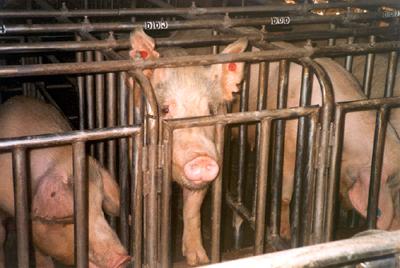 There's a revolution brewing in Arizona, a revolution that threatens to dismantle the very fabric of our families, communities, and our economy. And if you think it can't happen in your community, watch out. These revolutionaries are on the move!
Extreme liberal agitators have invaded Arizona's political process with a proposition that goes way too far. Now sit down before you read the language of the proposed law. You may start to wonder which planet these people come from.
A person shall not tether or confine any pig during pregnancy or any calf raised for veal, on a farm, for all or the majority of any day, in a manner that prevents such animal from:
- Lying down and fully extending his or her limbs; or
- Turning around freely.
That's right. They want pigs and calves to stretch out and turn around! Clearly, this must not be allowed. Fortunately, the good people with " No on 204" are waging a campaign with the kind of clarity, simplicity, and common sense that this issue deserves. Their advertisements cut right to the heart of the issue:
Why Oppose Prop 204?
1. Unnecessary. Arizona farmers and ranchers are honest/hardworking people that treat animals humanely and provide them a safe and healthy environment.
That's important. Honest/hardworking people have a right to confine their pigs/calves any way they want. In fact, it's in the best interest of those pigs/calves to face forward in the same narrow/metal cage their entire lives. Just how long do you think they would survive in the wild?
2. Foreign Meat. Prop 204 is part of a national political campaign going state-by-state to slowly break down farms and ranches in America.
Ok, this one might be a little confusing. What does "foreign meat" have to do with this state-by-state campaign of terror? What they mean to say - and right they are! - is that as soon as you get American pigs/calves turning and lying around with legs outstretched (they might as well be sipping martinis!), dirty/dark-skinned ranchers from afar are going flood our markets with cheap/foreign meat, and you won't be surprised to know that they raise dirty/dark-skinned meat too!
The state-by-state campaign is a different thing entirely, which brings us to rebuttal number three:
3. Using Arizona. Out-of-state animal rights groups brought Prop. 204 to Arizona just like they did to Florida in 2002.
Just like those rabble-rousing/liberal carpetbaggers forced their anti-slavery and civil rights ideas on Dixie, they're at it again with their wild ideas about the humane treatment of animals. Hogwash. That's the slogan of the No on 204 campaign, and it's dead on. Hogwash. The Humane Society of the U.S. and Farm Santuary, the two biggest contributors to the Prop. 204 campaign, are from Washington, DC and upstate New York, respectively. Ok, sure, our No on 204 campaign receives a major portion of its funding from two Washington, DC-based groups (American Farm Bureau Federation, National Pork Producers Council) but really, that's different. Really. Very different.
The battle over pig stretching in Arizona is not humane for agribusiness. The welfare of animals is Communist propaganda designed to put honest/hardworking corporations out of business. Join me at the polls to vote no on Prop. 204 and yes to animal cruelty. Labels: animal rights, politics
| »
Tuesday, September 19, 2006 by Jeff
 The Seattle Times is running a series this week on illegal immigration. If you want an easy intro to the many facets of this complicated debate you might want to check it out. An excerpt from today's article: The Seattle Times is running a series this week on illegal immigration. If you want an easy intro to the many facets of this complicated debate you might want to check it out. An excerpt from today's article:
If the supply of illegal workers were cut off, wages for those low-skilled jobs presumably would have to rise enough to attract legal workers into them. If, hypothetically, wage levels rose by a third, that would either add around $1,600 to the cost of the typical house or shave half a percentage point off the builder's 12 percent average profit margin.
"If I'm buying just one home, there's not that big an impact," Chiswick [an economist at the University of Illinois, Chicago] said. "But if I'm building a lot of homes and I can save a few thousand on each one.... "
[...]
Of course, the "illegal-immigrant discount" affects different layers of society differently.
The more often you eat out, stay in hotels or get your yard trimmed, the more you benefit from the illegal-immigrant discount.
And by increasing the supply of low-skilled labor relative to high-skilled labor, illegal immigration effectively boosts the purchasing power of the better-educated, more-skilled — and richer — portion of society. The bottom line seems to be that undocumented workers (the kinder, gentler alternative to tagging poor latino families "illegal") depress wages but have very little impact on the pricetags of our food, homes, and hotels. Although, because these small differences add up when you buy in quantity, look for the rich cats to vociferously defend the status quo to maintain profit margins and an inexpensive, if illegal, workforce.
See the whole report here:
America's Immigration Dilemma: A Special Report
Labels: immigration, politics
| »
Friday, August 25, 2006 by Jeff
A national poll conducted this week by SurveyUSA shows that a whopping 42% of Americans (± 2.4%) believe that we're heading toward World War III! And if that isn't discouraging enough, an additional 20% assert that it's already begun.
 So which party do you think will run on the "Victory in III" platform?
 Labels: politics
| »
|
 Jeff A. Larson
Sociologist, Arizona.
- jeremy | June 30, 2007 9:31 PM
- Jeff | July 02, 2007 1:27 PM
- marc | May 11, 2007 7:09 PM
- | May 09, 2007 12:57 PM
- | February 09, 2007 3:22 PM
- Jeff | February 09, 2007 4:21 PM
- | January 20, 2007 11:03 AM
- | January 20, 2007 12:59 PM
- | January 22, 2007 5:57 AM
- marc | January 23, 2007 8:08 AM
- erica | January 24, 2007 11:21 AM
- | February 17, 2007 3:39 PM
- joanna | December 09, 2006 10:26 PM
- marc | December 13, 2006 7:57 AM
- joanna | December 23, 2006 10:22 PM
- | November 01, 2006 8:12 AM
- | November 06, 2006 4:58 PM
- | November 16, 2009 6:15 PM
- | April 22, 2010 8:00 AM
|
 He's dropped "consumer protection" for the "citizen participation." He's flouted political propriety by campaigning for president. He's flung himself onto the machinery of U.S. politics. Now, Ralph Nader is, once again, considering a run for the presidency.